Digital identity
Private ID proofs
Director of Product, Concordium
TL;DR
Concordium's identity layer is cryptographically brilliant and also hard to use. We distilled it into a dedicated ID app: verify once, hold your credential on your own device, and prove facts like "over 18" with zero-knowledge proofs — revealing nothing else. Researched, prototyped, and launched within a year.
Background: a blockchain with a complex identity layer
Concordium is a public layer-1 blockchain with a rare design decision at its core: identity is built into the protocol itself. Founded in 2018 by Lars Seier Christensen, co-founder of Saxo Bank, its science was developed with leading cryptographers — among them Ivan Damgård (Aarhus University’s COBRA research centre) and Ueli Maurer (ETH Zurich).
Every participant on the network verifies their real-world identity with an identity provider before opening an account — a full KYC check. In the web3 world this is an anti-pattern: users expect to generate a keypair and join a network in seconds, anonymously. Concordium instead sits closer to the existing financial system, where identity verification is the price of regulatory compliance and fraud prevention.
The counterweight is privacy. Concordium was designed from the ground up so that verified identity never touches the chain: accounts link to a user’s identity credential through zero-knowledge proofs, personal data stays off-chain, and anonymity can only be lifted through a regulated legal process. It is a genuinely elegant construction — and precisely because of that strong commitment to privacy, managing identity credentials is technically constrained and cumbersome for ordinary users. The cryptography solved the hard problem; the experience of using it remained a deep product problem.
Solution: a dedicated ID app
The answer was to lift the identity lifecycle out of the wallet and into a standalone, self-custodial app for iOS and Android: Concordium ID. You verify once with a trusted identity provider, receive a private cryptographic credential stored only on your device, and from there create on-chain accounts or answer verification requests — scan a QR code, approve a proof, done. Via WalletConnect, third-party and multi-chain wallets can plug into Concordium’s identity layer without building any of it natively.
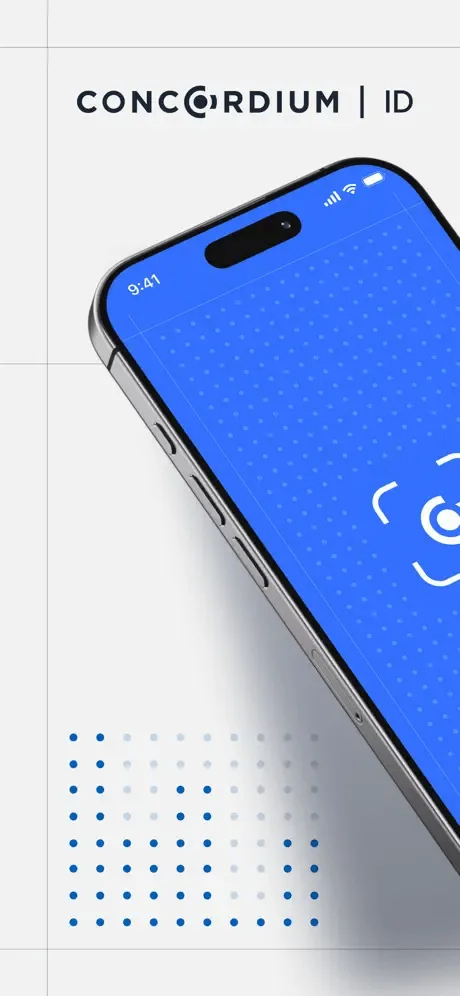
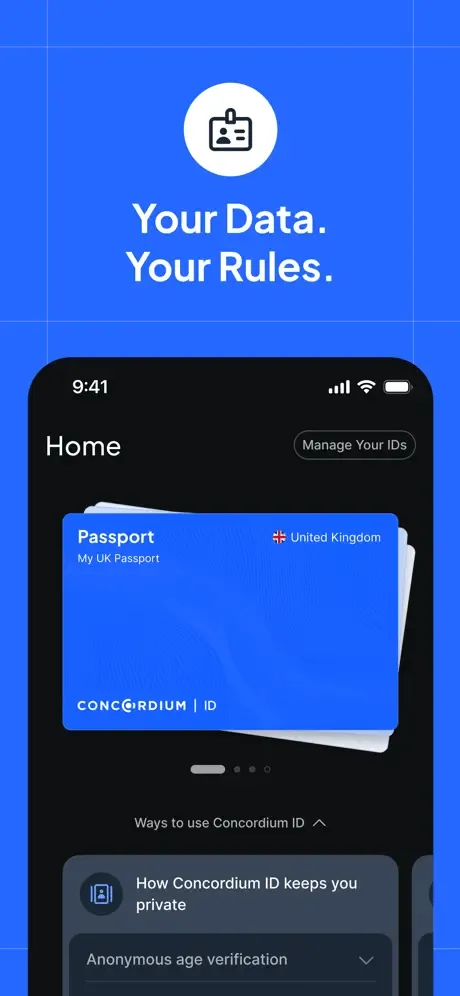
The key feature: selective disclosure. The app can prove a single fact about you — over 18, a citizen, not a resident of a given country — while concealing every other personal identifier, provably. You verify once, then re-authenticate anywhere in seconds with a QR scan, instead of repeating document checks across every web2 and web3 platform. No document upload per service, no central honeypot of personal data.
Two architectural decisions did a lot of the heavy lifting. First, the app deliberately isolates identity keys from financial transaction-signing keys — a clean separation of funds and identity that strengthens security and makes features like cloud backup of credentials possible (and why importing a seed phrase from a money wallet into the ID app is firmly discouraged). Second, the app ships with an SDK, so the integration cost of Concordium’s identity layer moves out of every wallet and into one dedicated application — third-party wallets get identity verification and account creation almost for free.
Getting the experience right mattered as much as the cryptography, because provable is not the same as believable. I ran the design department through a fast 0-to-1 process: prototypes built with AI in days, then tested the same week in London with non-technical people who owed our claims nothing. Three findings shaped the product:
- Privacy you can see beats privacy you’re promised. People don’t weigh a privacy claim; they watch what the app does. So each screen shows exactly what is shared — and nothing else.
- Explaining “zero-knowledge proofs” spent trust rather than building it. An unfamiliar term reads as something to take on faith. We cut the jargon and showed a plain promise with a simple visual instead.
- What feels appropriate is set by the moment, not the feature. The same disclosure felt safe in one context and intrusive in another, so each proving moment asks only for what it genuinely warrants.
Launch and success story
Concordium ID shipped to the App Store and Google Play in August 2025 — researched, prototyped, built, and launched within the year. Its debut use case took aim at one of the internet’s most visible identity failures: age verification, which regulators increasingly demand and which most services solve by hoarding copies of passports. The timing was no accident: the UK Online Safety Act, the EU’s MiCA framework with its AML/KYC obligations, and age-verification mandates landing on social platforms all point the same way — identity checks are becoming unavoidable, and the question is whether they happen privately or by uploading your passport to yet another database.
The launch came with real distribution, and validated both integration paths the architecture was designed for. Coin98, a multi-chain wallet with millions of users, adopted the ID app directly for account creation and identity verification — cutting its integration time dramatically because the app carries the whole identity lifecycle. Other wallets, like SafePal, chose the opposite route and integrated Concordium’s full suite natively. For businesses, verification events can be anchored on-chain as encrypted digests — an audit trail that satisfies regulators without exposing any raw personal data.
We launched with a deliberate three-step roadmap, introduced to the community in a live AMA and walkthrough I hosted with product manager Arjun Yadav:
- V1 — wallet onboarding. Account creation and initial identity verification for third-party wallets: the integration problem, solved first.
- V2 — simplified UX and attribute proofs. Frictionless onboarding that abstracts seed phrases away, plus zero-knowledge age checks.
- V3 — privacy-first UX and “verify & pay”. A private, incognito-style experience, and combining age-gated compliance with stablecoin payments via protocol-level tokens in a single flow.
Fully non-custodial, with no user data collected by the developer, the app has kept growing with the community since launch — supported by community testing programmes for each release and planned onboarding incentives. A portable, reusable, privacy-first ID for both web2 and web3 services, and proof that deep cryptography can feel simple.